Reading Milestones: A Family Guide to Tracking Progress (and Screen Time)
Nookly Team · 6 min read
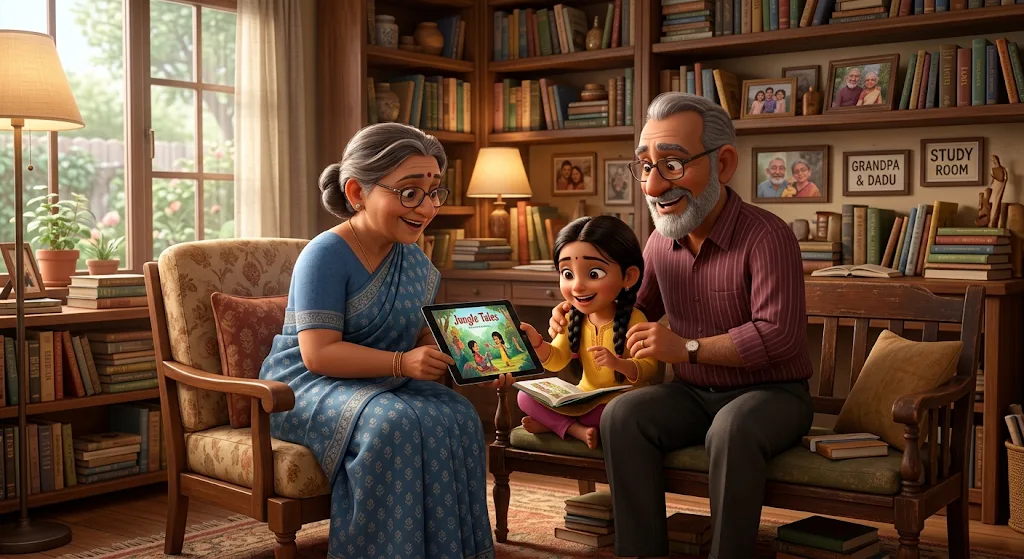
Every family has the moment. A child points at a cereal box and says a word out loud, and the grown-ups at the table go quiet. Did she just read that? Moments like this feel like magic. They're also milestones, small visible signs that something big is happening underneath.
Milestones can also bring worry. A cousin is reading chapter books. A classmate knows every letter. Is your child behind? This guide is here to help you read the map calmly: what reading milestones usually look like, how to notice progress at home, and what research says about personalization and screen time.
Milestones are a range, not a deadline
Reading develops in a rough order, but children move through it at different speeds. Health and education bodies describe milestones as what most children do by a certain age, not what every child must do. The CDC's milestone checklists are a good example: they focus on language and communication in the early years, and they're meant as a conversation starter with your child's doctor, not a test.
Think of each milestone as a landmark. Passing it a little later is common. What matters most is steady movement forward, and knowing when to ask for help.
What reading milestones often look like
Side by side
On a phone, swipe the table sideways to see every column.
| Age | What you might notice | How you can help |
|---|---|---|
| 1 to 2 | Pointing at pictures, turning pages, babbling along to familiar books | Read the same favorites often; name what they point at |
| 2 to 3 | Finishing lines of a known book, enjoying rhymes, 'reading' to toys | Pause and let them fill in the last word |
| 3 to 4 | Recognizing some letters, especially in their name; noticing signs and logos | Play 'I spy' with first sounds; point to words as you read |
| 4 to 5 | Hearing rhymes and first sounds; linking some letters to their sounds | Clap syllables; make silly rhyme lists together |
| 5 to 6 | Sounding out simple words; reading a few common words by sight | Offer short texts that use sounds they've been taught |
| 6 to 7 | Reading simple books with growing accuracy; self-correcting mistakes | Let them read to you; praise effort and fixes, not just speed |
| 7 to 9 | Reading more smoothly; retelling stories; reading to learn about topics they love | Talk about the story: what happened, why, what might come next |
These are typical patterns drawn from widely used guidance, not a diagnostic tool. Schools may use different benchmarks, and your child's teacher is the best person to tell you where they sit against their own curriculum.
What the research says actually builds readers
A U.S. government practice guide on foundational reading summarizes the evidence for young readers: children benefit from explicit teaching of how letters and sounds work, lots of practice reading connected text, and growing vocabulary and language skills along the way. Put simply, someone needs to teach the code clearly, and then children need plenty of reading that uses it.
That second part, practice, is where home matters most. And practice depends on something research can't prescribe: a child who wants to sit down and do it.
Where personalization fits
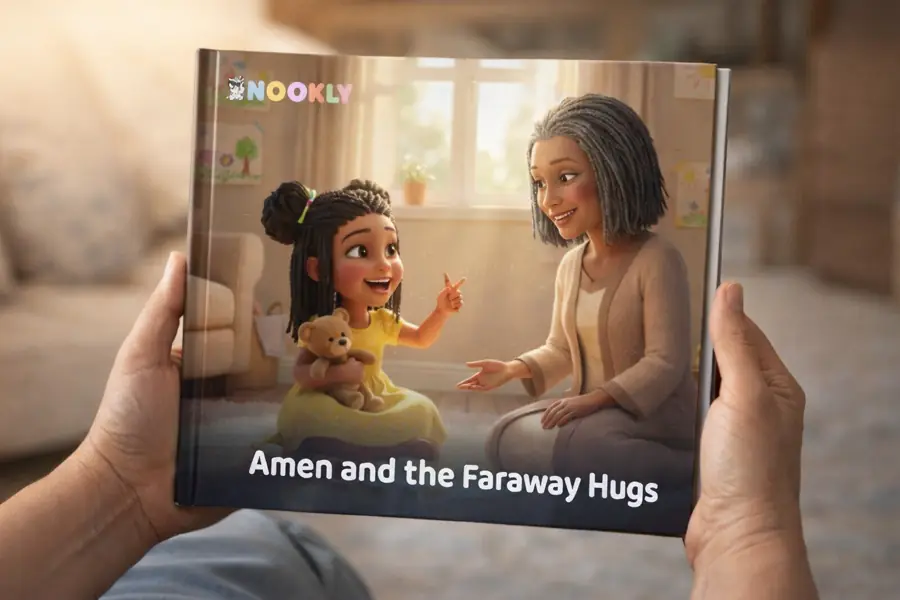
There's a reason children light up when a story has their name in it. Studies of personalized books suggest that children can be more engaged with stories that feature them. In one study by Kucirkova, Messer and Sheehy, young children learned more new words from a book personalized for them, and their parents noticed the difference in how children talked about the story.
It's worth being careful about what that means. Personalization is not a replacement for teaching the letter-sound code. It's a way to make practice more inviting, so children read more often and stay with a text a little longer. The most useful personalization does two things at once: it's about what your child loves, and it uses the sounds and words they're actually learning.
That's how Nookly approaches reading. As an AI learning platform, Nookly lets you describe your child's interests and the sounds they're practicing, then helps you make a short story, sound game or activity around both. You read it first, adjust anything that doesn't fit, and decide how to share it.
How to track progress without turning home into school
You don't need a spreadsheet. A small notebook, or a note on your phone, works well. Once a week or so, jot down one or two things:
- New sounds or words. "Read 'ship' on her own." "Knows 'the' and 'said' by sight."
- How they tackle a hard word. Do they look at the letters, guess from the picture, or give up? Looking at the letters is the habit to celebrate.
- Understanding. Can they tell you what happened in a story, in order?
- Interest. What did they choose to read? What did they ask to read again?
Over a few months, these notes tell a story of their own. You'll see patterns, like a sound that keeps tripping them up or a topic that always gets them reading. That's useful to share with a teacher, and it helps you choose what to practice next.
If you notice that your child isn't moving forward over several months, struggles to hear rhymes or first sounds, or reading seems to cause real distress, talk to their teacher or doctor. Asking early is never an overreaction.
Literacy and screen time
Screens are part of family life, and that includes reading. The question is less "screen or no screen" and more "what kind, how much, and with whom."
The American Academy of Pediatrics recommends that for children ages two to five, screen use be limited to about an hour a day of high-quality content, ideally shared with an adult who can talk about what they're seeing. For younger children, it suggests avoiding most screen use apart from video chatting. For older children, the focus shifts to consistent limits and making sure screens don't crowd out sleep, play and time together.
Research on reading itself adds a useful nuance. A 2018 meta-analysis by Delgado and colleagues found that, on average, readers understood informational texts somewhat better on paper than on screens, especially when under time pressure. That doesn't make screens bad for reading. It does suggest a few simple habits:
- Read together. Shared reading on a tablet can still be rich if you pause, point and talk.
- Mix formats. Use a screen to discover a story, then print it or read a paper book on the same topic.
- Choose active over passive. A story your child reads aloud to you is different from a video that plays on its own.
- Keep it short. Stop while they still want more.
Nookly is built with that balance in mind. Many pieces can be printed, read aloud together or turned into an off-screen activity, so the screen is where the idea starts, not where the reading ends.
A simple plan for this week
Pick one thing your child loves right now. Ask their teacher, or check their program, for two or three sounds they're working on. Make a short story or clue game that uses both. Read it together, then write one line in your notebook about what you noticed.
That's it. One small win, written down. Next week, do it again. Milestones will take care of themselves more often than you think, and you'll have a record of the journey to look back on together.
Sources checked September 28, 2026: Institute of Education Sciences, foundational reading practice guide; CDC, Learn the Signs. Act Early. developmental milestones; American Academy of Pediatrics, media and young minds; Delgado et al. (2018), print vs. digital reading comprehension meta-analysis; Kucirkova, Messer & Sheehy (2014), personalized books and young children. Nookly isn't affiliated with or endorsed by the organizations named.
From the Neighborhood
Try a ready-made bundle
Reading Comprehension Through Mystery StoriesMystery stories and clue cards that make kids read closely to find out what happens.View bundle- Early Reading & Phonics Foundations — Letter-sound and word-pattern decks for children still building decoding.