Nookly vs Lovevery vs LEGO: What Does Your Child Want to Play Next?
Nookly Team · 6 min read
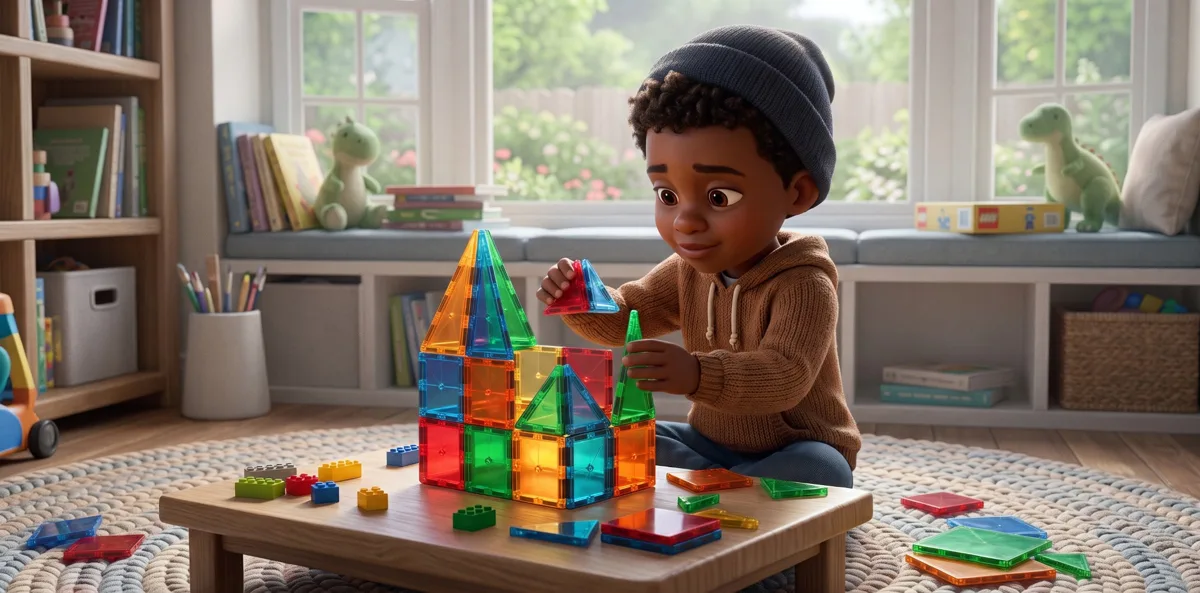
Your three-year-old has a toy box full of things, and plays with the same two cars. Your seven-year-old has a mountain of bricks and says there's "nothing to do." You're wondering whether they need something new, or just a new way into what they have.
You could look at a curated play kit designed for your child's stage. You could add more open-ended bricks. Or you could make a play invitation built around the toys and supplies you already own. These aren't either-or. Here's how they compare.
TL;DR: who wins where?
- Lovevery wins for curated physical play kits with playthings, activities and parent guidance matched to a child’s stage, all real materials delivered to your door.
- LEGO wins for open-ended building, with bricks that can be built and rebuilt endlessly. Choose age-rated sets; small bricks aren’t for toddlers.
- Nookly wins when you want a play invitation — a story, challenge cards or props — built around your child’s current interests and the toys and supplies you already have. It doesn’t ship toys.
Before buying anything, it can help to watch for a few days. What does your child keep choosing? What do they ignore? What games do they invent? The answers often point to what would genuinely add something, and what would just add clutter.
Not mutually exclusive
A kit, bricks and an invitation do different jobs. Lovevery provides new, curated materials for a stage. LEGO provides a flexible building material. Nookly provides an idea for how to play with what's around you. Many families use more than one.
Rotation helps too. Putting half the toys away for a few weeks and bringing them back later can make old toys feel new again, with no shopping at all.
Lovevery: curated for a stage
Lovevery describes its Play Kits as physical playthings and activities, with guidance for parents, designed for particular stages of early childhood. The strength is curation and quality: someone has thought carefully about what might interest a child at that age, and it arrives ready to go. The company also offers an app and other resources alongside the kits.
Kits are designed for early childhood stages, so check what's available for your child's age rather than assuming there's a kit for every year. And a kit, however lovely, is the same kit for every child at that stage.
LEGO: build, break, rebuild
LEGO Classic is built for free building and rebuilding. A car becomes a spaceship becomes a zoo.
The strength is flexibility. The limitation is that a big pile of bricks can feel like a blank page, and some kids need a spark to get going. Remember age ratings: small bricks are a choking hazard for toddlers.

Where Nookly fits
Nookly is a tool for adults to create learning pieces for one child. For play, that means invitations: a short story that sets up a pretend scenario, challenge cards, printable props like tickets, signs or maps, built around what your child loves and what you already have.
Here's where Nookly adds something different. You can say: "He's three. He only plays with his two red cars. We have a big cardboard box, masking tape and some toy animals." Nookly can help you make a picture story about two red cars who drive animals to the zoo, a simple masking-tape road map for the floor, and a few "delivery" cards ("Take the lion to the box!"). For your seven-year-old with the bricks: three building challenges around his love of pirates. No new toys required.
Nookly doesn't ship kits or bricks, and it doesn't claim to replace real materials. It's an idea for the toys you've got. You review everything first, and check any activity is safe for your child's age.
You can create a one-off experience, or set up a personalized learning plan called a Blueprint for an ongoing Goal, a finite plan, maybe a new play world each weekend.
A quick example. On Saturday you lay the masking-tape road across the living room floor. Your three-year-old drives the red cars along it, delivering animals to the cardboard zoo, again and again. Your seven-year-old, who said there was nothing to do, starts building fences out of bricks for each animal. By lunchtime, the zoo has a gift shop. Nobody bought anything new.
Using them together
A family might have a stage-based kit for their toddler, a box of bricks for their seven-year-old, and use Nookly to make an invitation that brings both together: a "zoo delivery" game where the big sibling builds enclosures and the little one drives the animals. The materials came from different places. The game came from your family.
Think about your child's mood and stage too. Some children love the novelty of something new arriving. Others are happiest going deep with the same few toys. Some need a spark; others just need time. Watching how your child plays is the best guide.
How to choose
If you'd like new, curated materials for your young child's stage, a play kit is worth a look. If you want a flexible building material that lasts for years, bricks. If you have plenty of toys but want fresh ideas built around your child's current interests, that's where Nookly helps.
And sometimes, the answer is none of the above: a cardboard box, a free afternoon and no plan at all.
Whatever you choose, remember that play belongs to the child. Kits, bricks and invitations are there to support it, not to direct it.
Watch before you buy
A simple habit helps with any toy decision. For one week, notice what your child plays with when nobody suggests anything. Is it the saucepans? The dress-up hats? The same three cars? Write it down. Those notes tell you whether they need new materials, a new idea for old materials, or simply more time with what they already love.
A sample request
"My eight-year-old loves bricks and pirates but says building is boring. Make three pirate-ship building challenges, each with a different constraint, a treasure map to hide in the living room, and a short pirate story that ends on a cliffhanger he has to build his way out of." Print it, pull out the bricks, and let him set sail.
Side by side
On a phone, swipe the table sideways to see every column.
| Lovevery | LEGO | Nookly | |
|---|---|---|---|
| Main job | Curated physical play kits with activities and parent guidance | Open-ended building with rebuildable bricks | Adult-made play invitations around one child |
| Materials | New playthings delivered | Bricks | The toys and supplies you already have |
| Personal context | Designed for a developmental stage | Whatever the child builds | The child’s interests, toys and home |
| Age notes | Designed for early childhood stages | Pick age-rated sets; small bricks aren’t for toddlers | Tailored by the adult, who checks safety |
| Formats | Physical kits plus app and resources | Physical sets and building ideas | Stories, challenge cards and printable props |
| Best moment | A thoughtful new set of materials | Building and rebuilding | A fresh game with old toys |
Descriptions checked September 28, 2026 from public Lovevery and LEGO pages. Nookly isn’t affiliated with either.
Toy box feeling tired? Make a play invitation around the toys you already have.
Sources checked September 28, 2026: Lovevery, what are The Play Kits; LEGO Classic. Nookly isn't affiliated with or endorsed by the organizations named.
From the Neighborhood
Try a ready-made bundle
Easy STEM Activities: Ramps, Floating and BridgesRamps, floating and bridge-building for build-break-rebuild play.View bundle- Learning Halves and Quarters Through Play — Sharing snacks into halves and quarters.